How to Set Up a Portable PA System for an Event– No matter if you’re planning to host a wedding sangeet, corporate event, school function, or another small outdoor concert, the sound quality can be the difference between success and failure. Portable PA Systems will allow you to produce rich, high-quality sound in any setting – without breaking the bank or having to install a permanent system. Setting up a portable PA system can be daunting if you’ve never done it before, but with a handful of equipment and some preparation, you can have a world-class audio system operating in under an hour.
In this step-by-step guide, we’ll teach you everything you need to know about how to set up a portable PA system, from selecting the best gear, to dialing your sound.
Understand What a Portable PA System Includes
A standard portable PA system consists of a handful of components that function together to amplify and transmit sound. Here’s the image of them:
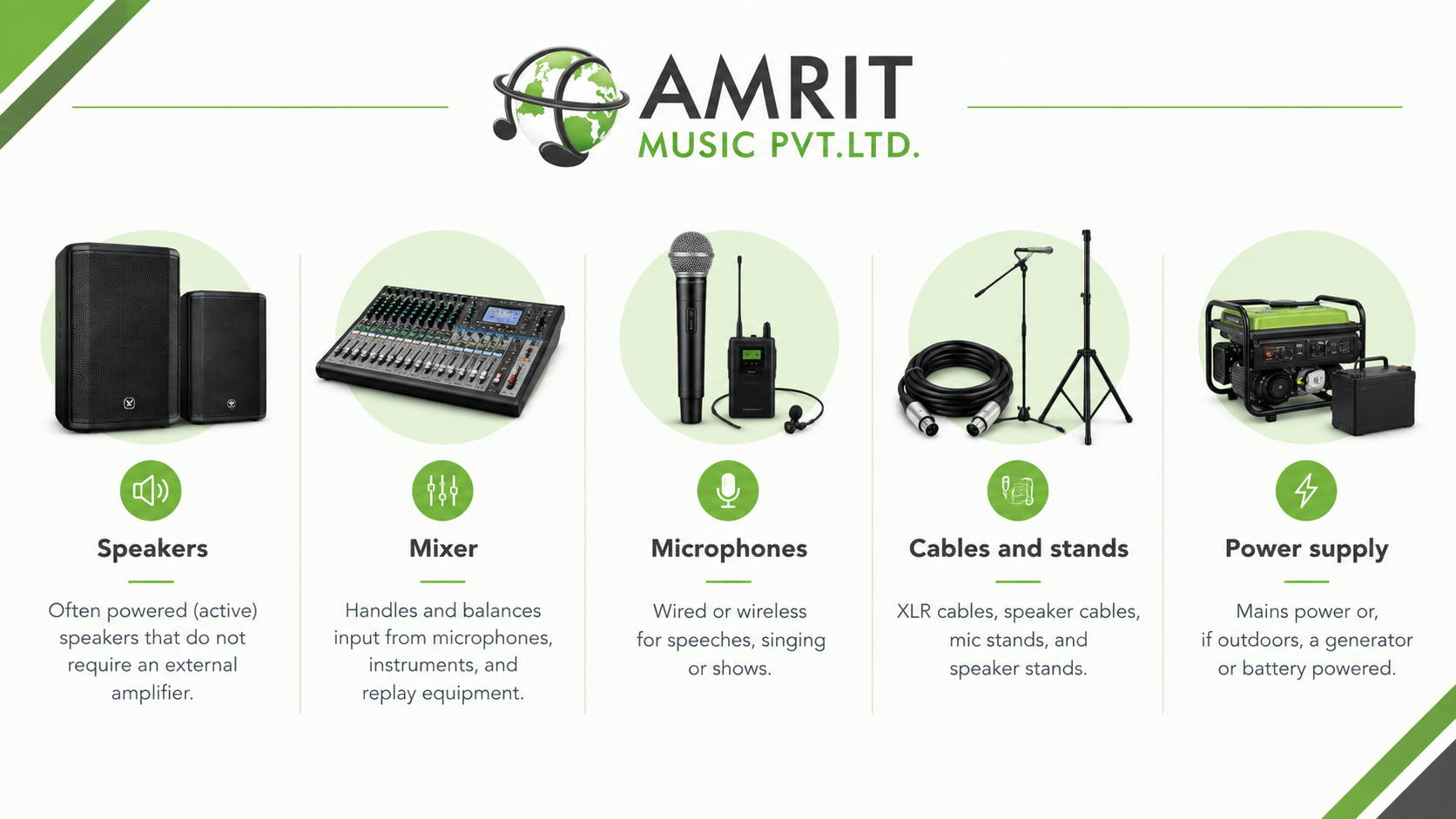
Most of today’s manufacturers provide all-in-one portable PA systems, where the mixer and amp are built right into the speaker itself, which makes setup much easier – an ideal choice if you’re just getting started.
Select the Appropriate System based on Event Size
First consider the scale of your event before renting or purchasing equipment:
Small indoors gathering (up to 50 people): a powered speaker with a built-in mixer can often serve as the only sound system.
Medium events (50-150 people): Think about stereo powered speakers and a subwoofer.
Events over 150 people large or out of doors: Expect to play with higher-watt speakers, more subwoofers, and a separate mixer to get more from multiple inputs.
Generally speaking, that’s going to be a lot more powerful for outdoor events than it is for indoor events, primarily because there are no walls to reflect the sound indoors.
How to How to Set Up a Portable PA System for an Event?
Knowing the steps makes the rate of error less. By following step-by-step guide you able to set up a portable PA system for a event:
Plan Your Speaker Placement
The positioning of your speakers is extremely important to the quality of the sound. Make sure to follow these guidelines:
- Place the speakers at ear level or slightly higher, facing toward the audience.
- Position stereo speakers in various locations, and angle them toward each other just a little bit, to achieve balanced sound coverage throughout the room or site.
- Never set speakers flat against a wall or into a corner of the room. This can result in boomy, muddy bass.
- Make sure you place loud speakers well away from mics. Avoid the dreaded high-pitched squealing sound of feedback occurring when a mic picks up sound from the very speakers it’s connected to.
Additional tips: If a subwoofer is being used, keep it on the floor since lows tend not to be directional – so consider putting it near the middle of your audience area.
Prepare the Mixer and Hook Up Your Inputs
Now, after your speakers are placed, you will connect everything via the mixer:
- Connect each instrument or microphone to a different channel on the mixer with either ¼ inch or XLR cables.
- Plug in your external devices (laptop, phone or music player) to the auxiliary or Bluetooth input.
- Connect the main output from the mixer to your speakers (directly, or via an amplifier if you are using passive speakers).
- If you are using two or more microphones, make sure to label each one so you can easily identify and make adjustments on the fly.
Leave all channel faders (volume sliders) down before turning on the system. This helps avoid any rush of sound that might suddenly blast out of your system and make your speakers boom or frighten your audience.
Power On in the Right Order
Whether you turn off your equipment is more important than you think:
- Turn on the mixer first.
- Turn on the speakers or amplifier last.
- Turn off the equipment in reverse order: amplifier/speakers, then the mixer.
This order prevents you from having to deal with the loud pop or thump heard when you turn on or turn off equipment out of sequence, which can damage your speakers and your hearing.
Perform a Sound Check Ahead of the Guests’ Arrival
Don’t miss the sound check – it is the most crucial step to a smooth event. These simple steps should get you through your sound check:
- Begin with all channels at a low volume and slowly increase each input one at a time.
- Test all the microphones one-by-one at the sound level you will use during the event.
- Stroll the venue as a person’s voice comes through a microphone to make sure the sound is even throughout the room and there are no dead spots.
- Pay attention to any feedback and reduce it by lowering the gain for the offending channel or by moving the microphone or speaker.
- Play a musical track to get a general idea of how the Bass, Mid, and Treble are balanced.
Finish your sound check at least 30-45 minutes before guests arrive, so you have time to make adjustments if necessary.
Manage Cables and Safety
It should also appear professional and be safe to use near:
- Cable tie or gaffer tape cables to walls or under rugs that cross walkways.
- Always carry a few spare cables and batteries.
- If using equipment outside, keep the equipment dry and out of direct sunlight and use a weatherproof power supply.
- Don’t plug too many devices into one socket or extension cord.
Designate Someone to Watch out for Sound During the Event
Despite having the best possible sound check, once the room is packed and people start talking, the atmosphere will shift – people take up room and sound reflected in a room. It’s best to have a person by the mixer throughout the event so you can do small volume adjustments every now and then.
Common Mistakes to Avoid
Even seasoned stage builders encounter unnecessary issues when assembling a PA system. Be mindful of these common traps:
- Failing to multiply your requirements: An audio setup that seems perfect for your lounge gathering might be woefully inadequate outside or in a bigger venue. Never be stingy in the sizes of your kit.
- Neglecting the acoustics of the room: Rooms with hard reflective surfaces (tile floors, wide open reflective halls with lots of glass or bare walls, etc.) sound totally different from a room with thick carpets, soft furnishings, etc. – modify your EQ and how you position speakers accordingly.
- Tripping over cables: Loosely secured cables aren’t just unsightly; they are a serious hazard to your visitors and performers.
- Lost backup cables or batteries: Wireless mics can run out of power at the worst possible time, and cabling often refuses to cooperate. Keep a small spare kit on hand for those times when you need a quick fix.
- Levels too high in sound check: It’s common to test each item loudly and proudly, but bear in mind that a room full of people will absorb more sound, so you’ll generally be required to increase levels when your guests arrive instead of decreasing.
Renting vs Buying a Portable PA System
If you only need a portable PA for the odd event, renting may be your best option. Most audio suppliers will rent a package, which normally consists of speakers, a mixer, microphones and cables all for one price, saving you the cost of purchasing.
But if you hold events often (as an artist, event organiser, DJ or venue) – then getting your own system often pays for itself in the long run. And, of course, buying your own system means you get to learn the idiosyncrasies of your own gear and get to set it up more quickly and comfortably every time.
The Real Challenges Facing People (and How to Fix Them)
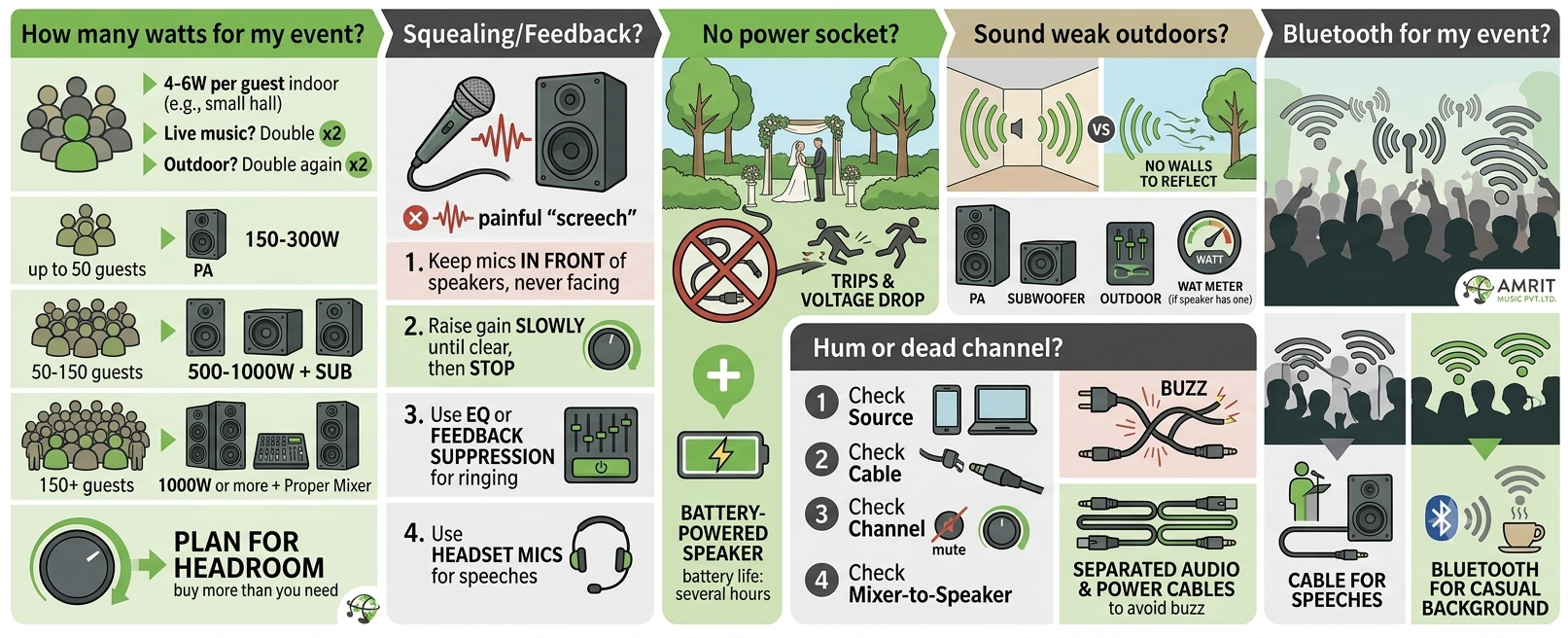
Lower, we provide me infographical image with visual for better understanding on real challenges that people are facing and how to fix them:
Final Thoughts
Using a PA system doesn’t have to be an excruciating process. Whether you’re hosting a little gathering with 20 people or a large gathering of a few hundred, there is an effective and professional way to make your sound. Planning, preparation, and good, quality gear means you won’t have to worry about choosing the right sound for your event.
As music enthusiasts with 50+ years in the business, we stock everything you need from guitars, drums, amplifiers, and sound gear to get the sound you’re after. Come in to the Amrit Music showroom or contact us for our experts’ suggestions on a portable PA system that suits your needs and budget.
FAQs
1. How many watts for 100 people in indoor events?
Allow for approximately 400-600W for speech or background music at 100 guests indoors. Double this if you’ll be having live music. Always allow for a little more power than you think you’ll require, a system operating below capacity will sound better and save your speakers.
2. What causes my microphone to squeal when I increase the volume?
That squeal. You’re getting, at the end of a speaker chain, what’s called feedback – the mic is capturing sound from the speakers and then re-amplifying that sound in a vicious circle. Keep the microphone pointed away from the speaker when you’re using one and increase the gain on sound check until it’s just hot, then stop.
3. If I am using one speaker and one mic do I need a separate mixer?
Not necessarily. These days, many portable PA speakers come equipped with their own mixer, which is the most straightforward configuration for beginners. The only time you require a standalone mixer is if you are controlling numerous microphones, instruments, and playback sources simultaneously.
4. Can we make Bluetooth more reliable?
Bluetooth will generally be okay if you just want it for a background playlist at a party, but certain venues with lots of phones in proximity are very noisy and transmitters can run into drop-outs. Use a cable for anything more important.
5. Which order should I turn on a PA?
Always power your mixer on first, and the speakers/amplifier on last. When powering off do the opposite, speakers first and mixer last. This avoids loud pops or thumps that will damage your speakers or startle your audience.
6. Why is my system less powerful outside than inside?
Inside, walls and ceiling bounce sound back to the ears; outside, there is no bouncing, sound just exits straight out into the atmosphere. This is the difference between feeling sound equipment is half as loud outside as well as the reason most outdoor venues require about twice the indoor wattage.
7. Which will benificial renting or buying a portable PA system?
If you run the odd event or two, then renting is generally the way to go – simple, cheaper, plus you usually get it all for the price of a mixer and mics. If you run loads of events, then a little investment makes a lot of sense – and you’ll get to be slick about setting it up yourself.
8. Why is my channel dead or why is there no sound?
Almost always is a signal-path problem, not a speaker problem. First double check the source, then the cable, then whether the channel is muted but gain at 0, then make sure the output of the mixer is plugged into the speaker.