The Harmonium is one of the most frequently played instruments in the music of India, especially devotional music such as bhajans and kirtans and classical music. Those who learn to play this instrument learn it mainly by observing, but reading notation to learn music is far better than the former method. This guide highlights how to read the notation for playing the harmonium, as well as various methods you may adopt to do so if you are a beginner to it.
What Is the Harmonium and What Is Its Role in Music?
The harmonium is a wind instrument wherein sound is produced by blowing the air through reeds via the bellows mechanism on pressing the keys. With the fixed tones of the harmonium keys, learning the instrument is relatively simple than those requiring pitch modulation.
The harmonium in Indian music is used for:
- Playing songs with vocalists in classical music performances
- Playing religious songs like bhajans and kirtans
- Learning melodies and ragas
It’s not like other instruments where piano notation is used, Indian harmonium lessons use Sargam notation. This incorporates the sounds of Indian music.
What Are the Fundamentals of Harmonium Music Notations in India (Sargam Notations)?
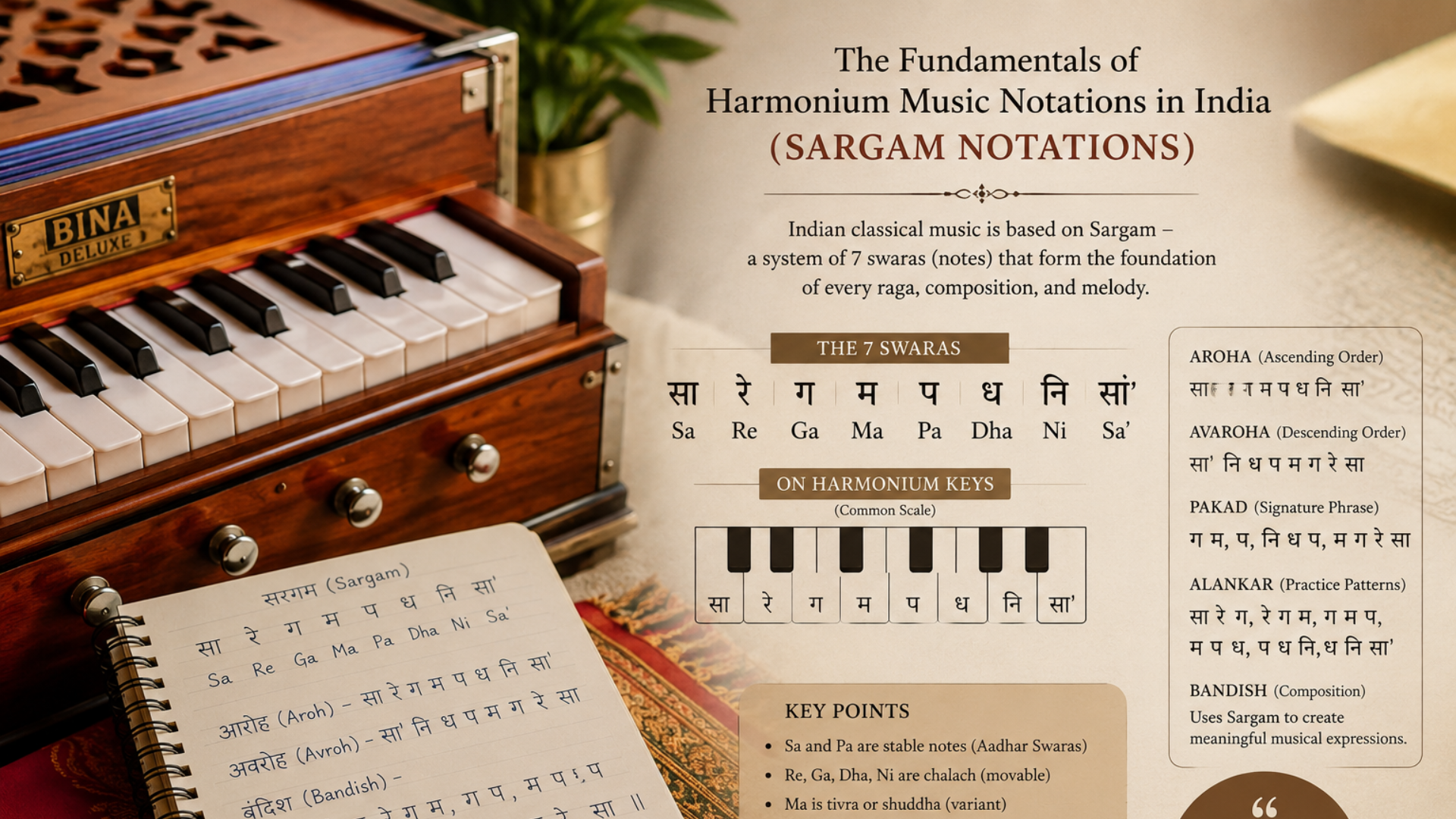
Sargam plays an important role in the notation system of harmonium, and there are seven basic notes:
- Sa
- Re
- Ga
- Ma
- Pa
- Dha
- Ni
- Sa (upper octave)
These are similar to western notes (C, D, E, F, G, A, B), although they can be extremely flexible in Indian music according to the scale.
How Harmonium Notation Sheet Constructed?
The construction of a harmonium notation sheet is always horizontal and comprises of:
- Notes (S, R, G, M, P, D, N)
- Beat divisions (Taals)
- Sections demarcated by bars
- Indication of rhythms
Sample construction:
S R G M | P M G R | S —–
These sections are in synchronization with the rhythm cycle.
Understanding of Rhythm (Taals) in Music
Rhythm plays as important a role as the notes do. In Indian classical music, rhythm cycles are referred to as taals.
Here are some examples of taals:
- Keharva Taal (8 Matras)
- Dadra Taal (6 Matras)
- Teentaal (16 Matras)
Matra refers to the number of beats.
Notations are made up of:
- Vertical lines “|” to indicate beat divisions
- “0” (Khali) for unoccupied beats
- Numbers to count beats
One must learn about the rhythm cycle before proceeding with a raga or a piece.
What Are the Symbols Used in Harmonium Notation?
Other than the notations of music itself, some of the symbols that make up the music notations are listed below:
Notations of notes:
- S, R, G, M, P, D, N letters
- Symbols with dots denoting a change in octave
Ornament symbols:
- Meend – Smooth transition from one note to the next
- Gamak – Quick oscillation between notes
- Kan swar – Ornamental note prior to the actual note
Rhythm notations:
- “|” is for bar line
- “0” for khali
- Counting beats with numbers
Repeat notation:
- Phrases repeat notation
- “—” for hold/sustain
What Are the Steps Involved in Reading Harmonium Notation?
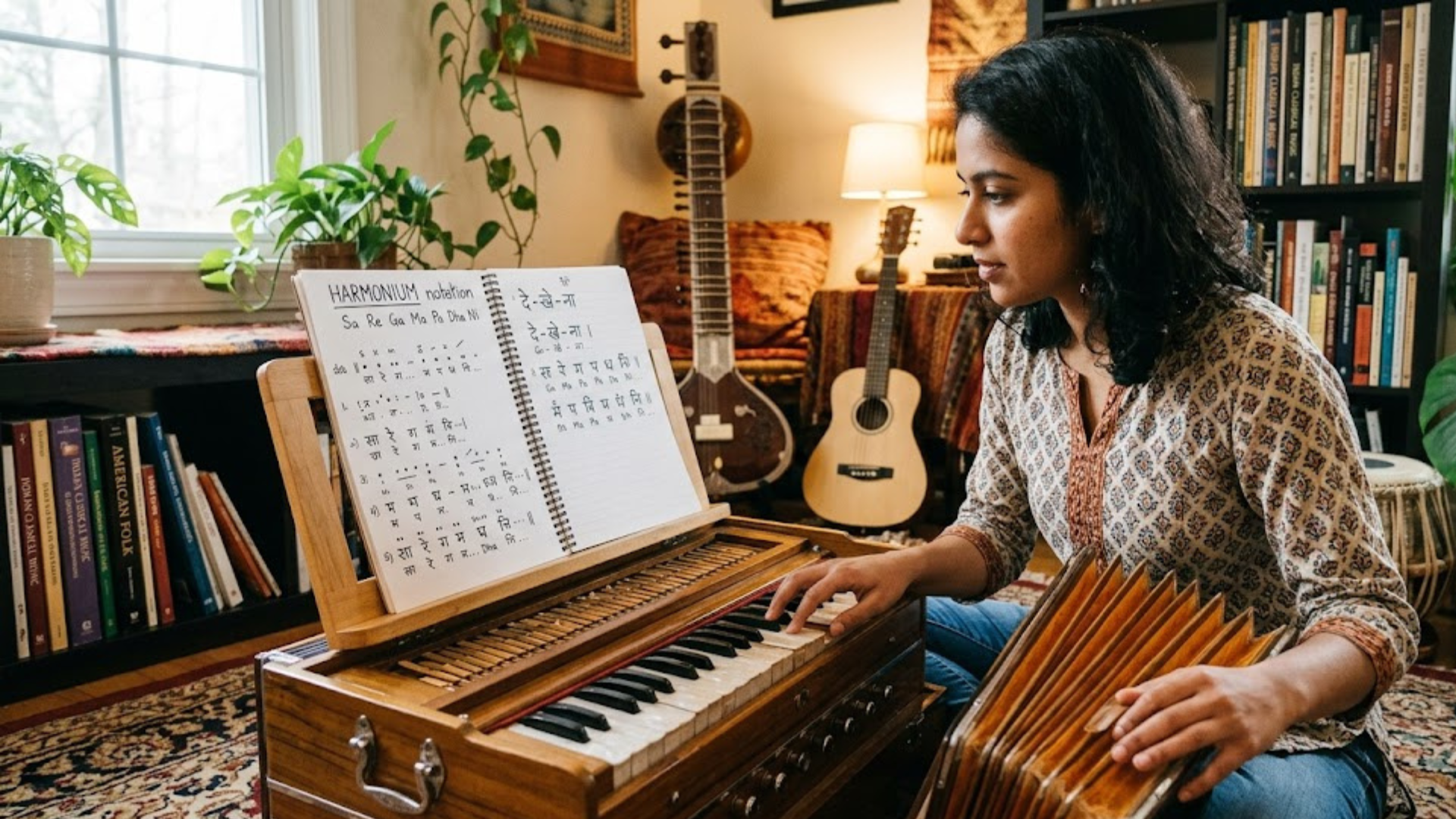
Step 1: Identify the Scale (Starting Note – Sa)
Identify the place of starting note. Place of Sa changes with singer’s scale.
It is very crucial because wrong scale leads to wrong melody!
Step 2: Start Reading Notes
Start reading notation from left to right. Each note represents each key on harmonium.
Example:
S R G M
Press corresponding keys.
Step 3: Learn Rhythm First Clap
Clap rhythm before playing notes always.
For example:
In case of Keharwa tal:
Clap on 1, 2, 3, 4 and repeat the cycle of 8 beats
Step 4: Combine Rhythm with Notes
Add rhythm to notes now
Example:
- S R G M | P M G R
- Press gradually
- Each beat has one note.
- No rush!
Step 5: Start Practicing Section-wise
Try never to start a song with a complete composition. Instead try practicing it section-wise.
- Verse 1
- Verse 2
- Refrain
Typical Mistakes in Early Learning
| MIstake | Description | Impact on Learning | Remedies |
| Not Playing with Rhythm | Doesn’t follow taal cycle of music. | Performance is not rhythmic. | Must always clap/count beats before playing any instrument. |
| Improper use of Octave | Misuses low and high octaves. | Loses concept of harmonization and produces improper music. | Needs to practice to get knowledge about positions of octaves. |
| Improper use of Starting Note of Harmonium | Incorrect setting of starting note (Sa). | Wrong performance from start to finish. | The starting note must correspond with the singer. |
| Speeding Up Instead of Mastering | Doesn’t know music but focuses on speed. | Likely to commit many mistakes in music. | Patient practice makes one skillful. |
| Doesn’t Practice Sargam | Lacks basic notes (Sargam). | Bases of reading notes become weaker. | Must practice daily. |
Effective Ways to Enhance Note Reading Ability
Sargam Practice Daily
Even minimum practice everyday improves your note recognition skills.
Slow Tempo Technique
Please remember that slow tempo is key because fast tempo comes later with practice.
Combining Music Listening & Reading
Audio + visual note reading will help understand better.
Reading Musically Separate Phrases
You may begin by reading musical phrases instead of reading full songs from the beginning.
Self Recording
This technique will improve your music reading because listening to yourself makes you aware of any mistakes.
Example of Simple Note Notations
You can see the simple notations in Keharwa tal as following:
S S R G | M G R S
Understanding of Notations:
- Every letter stands for a single note
- Vertical bars indicate rhythm division
- One note per beat
For Harmonium:
- Playing Sa two times in sequence
- Then, Re, Ga, etc
- No need to hurry
These are beginner’s steps.
Some Advanced Note Reading Tricks
After you become a skilled musician, you can try:
- Alankars (Ornaments)
Apply Meend & Gamak more effectively
- Ragas Note
Mood wise note notations will be handy
- Transposition
Moving tune to another key without changing the structure of the song
- Accompaniment Skills
Rhythmical accompaniment for singers
Practice Schedule for New Learners
First Two Weeks
- Sargam Practice
- Understanding of Keyboard Layout
Third-Fourth Weeks
- Basic Understanding of Notations
- Rhythm Practice
Fifth-Sixth Weeks
- Song Practice
- Timing Practice
Post Seventh Week
- Ornamentation Practice
- Understand Various Taals and Ragas
Patience is the most important aspect of learning.
Conclusion
Reading notations is far beyond understanding the signs. It is about understanding how music is created along with the rhythm, tunes, and expressions involved in the creation of it. Learning of the Harmonium becomes much simpler by understanding the concept of the reading of notation.
Be patient, start with the basic things, practice regularly and you can read the most complex songs with notation.
FAQs
Is knowledge about music theory necessary for learning notations?
Not necessarily. A certain amount of knowledge would do. You may start learning the art using Sargam and rhythms. Practice consistently and gradually, you will also learn the theory of music along with notations.
How much time is needed to learn the art of notation reading?
There can be no exact answer. But one needs regular practice. Notations can be learned within weeks provided that you practice on them daily for 15 – 30 minutes.
Which thing is most important in learning the art of notation reading?
The rhythmic part is very important. Even if you have mastered the notes, but if you do not have perfect rhythm, then it will never be good. First, you need to master the beat cycles before playing notations.
Is it possible to learn harmonium without learning notations?
Yes, it is. However, learning harmonium through notations would make the entire process quicker and efficient for you.
What is the way to notate music on a daily basis?
Sargam exercise should be done first, and then musical phrases should be read slowly. Rhythms have to be clapped, and harmonium has to be played.