How to Choose the Right Headphones for Music Production– If you ask ten producers what their single most critical piece of equipment is, most of them will probably say headphones. Whether you’re making beats from the comfort of your own bedroom, recording vocals, or mixing tracks to put out into the world, your headphones are your gateway to the sounds. When that gateway is broken, all of your decisions related to EQ, compression, reverb, and panning become unreliable.
The problem is, the market is saturated, and not all headphones are created with production in mind. This guide will help you cut through the noise and find headphones that help you create better music.
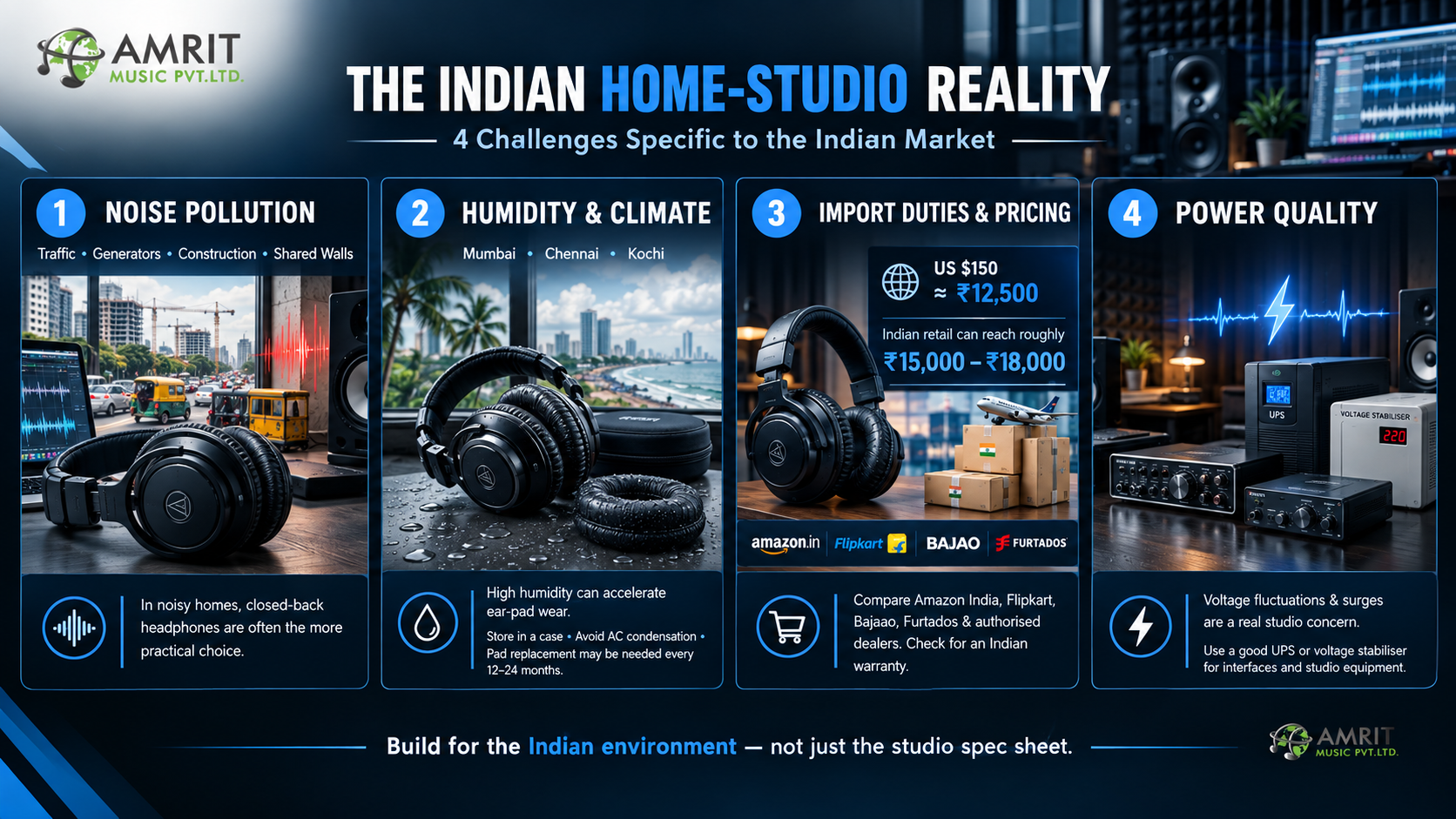
The Indian Home-Studio Reality: Challenges Specific to This Market
How to Choose the Right Headphones for Music Production?
Studio Headphones Vs Consumer Headphones
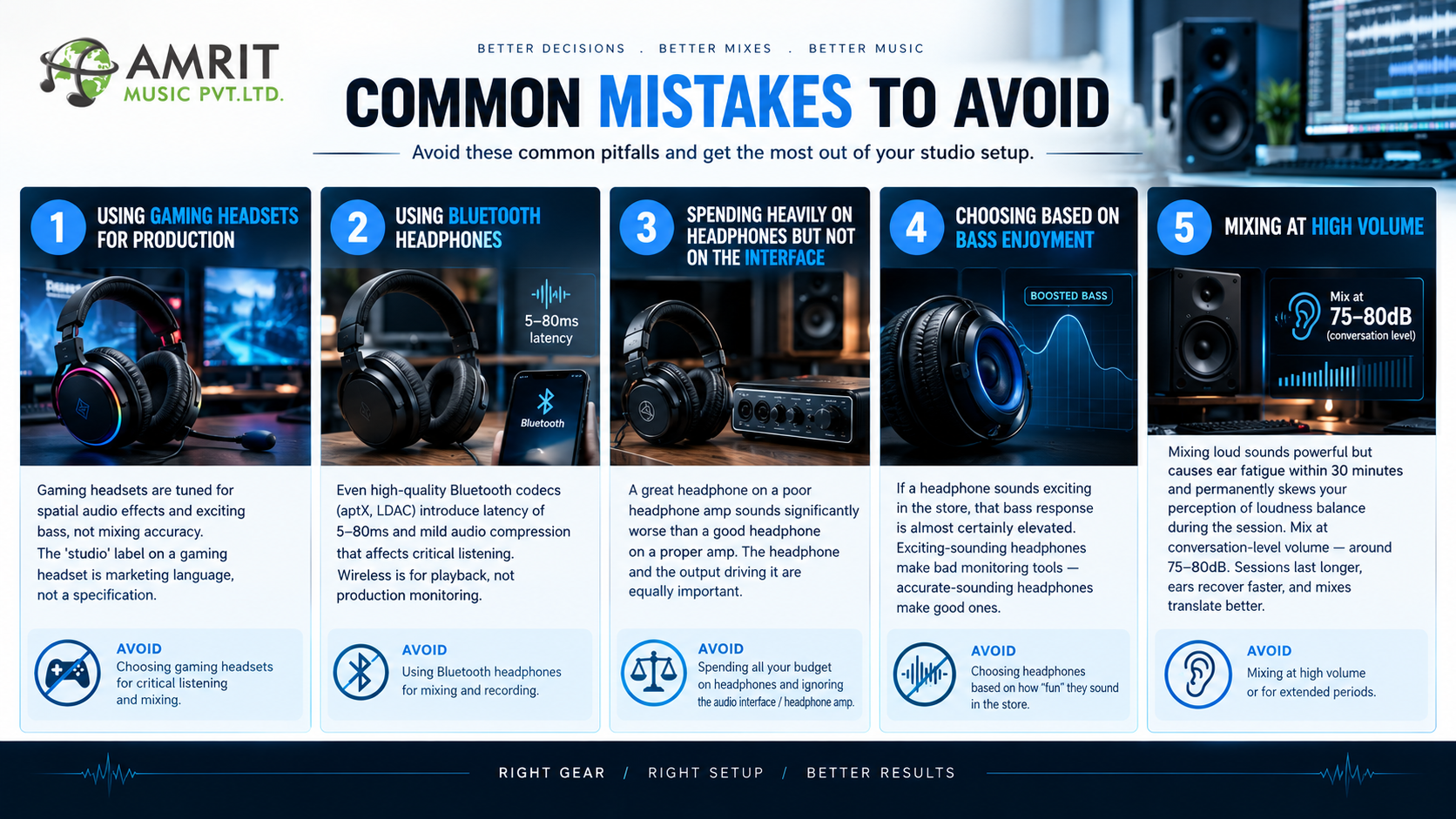
The majority of consumer headphones sound bright because of high frequencies and deep bass that make music listening more enjoyable. However, such headphones distort sounds and cannot show the true quality of a song. On the contrary, studio headphones are meant to provide an accurate sound representation. Thus, any problems with drums or vocals will be easily detected by a user.
Hence, as a buyer, ignore such terms like extra bass and immersive sound. Focus on headphones that are labeled studio reference, monitoring, or professional headphones.
Open-Back or Closed-Back?
It is an important decision to make at the outset as each one is best suited to a different task.
The closed-back headphones have closed ear cups that trap the sound inside. They provide high levels of isolation, making them the ideal choice for recording vocals and instruments as well as work in a noisy environment. Since they do not let much sound escape, you don’t need to worry about the click track bleeding out from your headphones.
The open-back headphones have open ear cups that allow sound and air to pass through. They generally provide a more realistic sound stage and are ideal for mixing purposes. However, they allow sound to leak from both ends and are therefore unsuitable for recording or when working in a shared space.
Feature Close-Backed Open-Backed:
| Feature | Close-Backed | Open-Backed |
| Best suited to | Recording, monitoring, noisy environments | Mixing and critical listening |
| Isolation | High | Low |
| Sound leaking | Less | More |
| Sound stage | Narrow and intimate | More spacious |
In the case of only being able to purchase one set, the safe choice would be a close-backed set. In case you usually mix in a quiet environment, then an open-backed set is worth considering.
Look for a Flat, Neutral Frequency Response
Flat frequency response is where the headphones reproduce bass, mid-range, and high frequencies all in an even manner, without favoring any of them.
Please don’t be deceived by specification sheets since every single pair has specifications of between 20 Hz and 20 kHz, which says nothing about the balance of the sound produced. Read up on some good reviews by independent websites and listen with your own ears. Test a track you are familiar with; you should get new details without any one part of the frequency range overpowering another.
Software correction curves are also provided by some brands and these try to correct the flatness of the headphone towards a standard curve, but again, it is better to start off with a good pair of headphones.
Comfort and Build Quality
Production takes time. A headphone that is comfortable for 20 minutes may turn out to be uncomfortable when used for 3 hours, which will affect decision making and reduce the length of the session. If you are wearing glasses, make sure the pads are not exerting an odd amount of pressure on the frames. Keep the following in mind:
- Weight and clamping force: Lighter headphones with less clamping force will be more comfortable to wear all day long.
- Pads: Velour pads will allow breathing, and leatherette pads are more isolating but hot.
- Size: Over-ear headphones that completely cover your ears will be more comfortable.
- Parts: Replaceable ear pads and cable can extend the life of a decent headphone by years.
- Understand Impedance and Sensitivity
Impedance is measured in ohms and represents the amount of resistance that headphones have for your sound source. Low-impedance headphones, under 50 ohms, will easily work with laptops and most audio interfaces. High impedance headphones, above 250 ohms, normally require a headphone amplifier in order to achieve proper sound.
Sensitivity determines the volume level that headphones produce for certain input. The higher the sensitivity, the louder headphones will be for the same power level. In the case of a home studio, which includes laptop and basic audio interface, 32 to 80 ohms headphones are quite a practical choice.
Wired Beats Wireless for Production
Always choose wired headphones. Bluetooth headphones have latency, meaning there will be a slight delay between whatever you are listening to and what you actually hear, which is not ideal for recording or playing virtual instruments. The compression also diminishes the audio quality. With wired headphones, you can expect to have consistent sound without any delays. Ensure that your headphones have a 3.5 mm to 6.35 mm converter.
Set a Realistic Budget
You don’t have to break the bank. The basic studio headphones from reputable manufacturers already offer greater accuracy compared to regular headphones of similar value. Mid-tier headphones will provide more detail, comfort, and build quality, while top-tier open-back headphones are good choices for experienced engineers who have their room properly treated and their own amplifier.
The best initial choice for the beginner will be decent closed-back headphones, thus saving enough budget for an audio interface and monitors. Examples of popular headphones for use in home studios are Audio-Technica ATH-M50x, Sony MDR-7506, and Beyerdynamic DT 770 Pro (closed-back), as well as Beyerdynamic DT 990 Pro or Sennheiser HD 600 (open-back). It is always preferable to test before purchase.
Common Mistakes to Avoid
Tips for Getting the Most From Your Headphones
- Listen to reference tracks: compare your mix with songs that have been professionally produced and that you know in and out.
- Test your mixes: listen to your mix on the speakers, earphones, and while driving before declaring it complete.
- Maintain healthy hearing practices: operate at medium loudness levels and take a break every hour.
- Do not depend on earphones alone: they tend to exaggerate stereo effects and low frequencies, which makes them unreliable in certain situations.
Final Thoughts
The right headphones are those that provide accurate sound reproduction, are comfortable during long hours of usage and are suitable for your working style. Select either open-back or closed-back design, look for neutral frequency response, impedance matching and wired connection. If you do that, then you will be making the right decisions when mixing from the very first day.
Looking for building or upgrading your studio? Check out our selection of instruments and musical gear at amritmusic.com, or come and see us in person at one of our Amrit Music Showrooms – we have been around for more than 50 years in the music industry.
FAQ
Which headphones, open back or closed back, are better for music production?
None is better than the other. Closed back is better when recording and for use in a noisy environment, while open back provides a much more natural sound stage that is important during mixing in a quiet environment.
Am I able to use standard headphones for music production?
Yes, but most consumer headphones accentuate the bass and treble. This makes them unsuitable for troubleshooting your mixes. The sound reproduction is much better using studio headphones.
Do I require a headphone amplifier?
Not necessarily. You can use any headphones below 50 ohms with your laptop or audio interface. For headphones over 250 ohms, you need a headphone amplifier.
Is it wise to use wireless headphones in music production?
Not really. There is latency in Bluetooth, meaning that there is some delay between playback and hearing. In addition, Bluetooth compresses audio. You want to have uncompressed audio that is delivered without any lag – very important for recording or playing virtual instruments.
How much should I pay for studio headphones?
There is no need to overspend. Entry-level studio headphones are better than almost any consumer headphones in terms of accuracy. As a beginner, you should choose a good closed-back model and save up for an interface.
How can I find out whether my headphones have a flat frequency response?
It’s always best to look at independent reviews and frequency measurements rather than rely on specs. Then play well-balanced songs: no lows, mids, and highs should prevail.