Practicing playing the drums in your house is challenging since the drums generate noise and vibrations. In case you do not have soundproofed walls in your room, there is a chance of disturbing others who live in the same building, or even in adjacent apartments.
This article will show how to soundproof your drum room considering the budget-friendly and mid-budget approaches. It will help reduce the amount of noise and vibrations in order to provide yourself with a comfortable working space.
However, before starting soundproofing, it is important to point out the main difference between soundproofing and acoustic treatment. The former prevents the transmission of sound waves through the wall, while the latter helps in improving sound quality by preventing echo inside the room. Soundproofing requires more effort than placing foam panels.
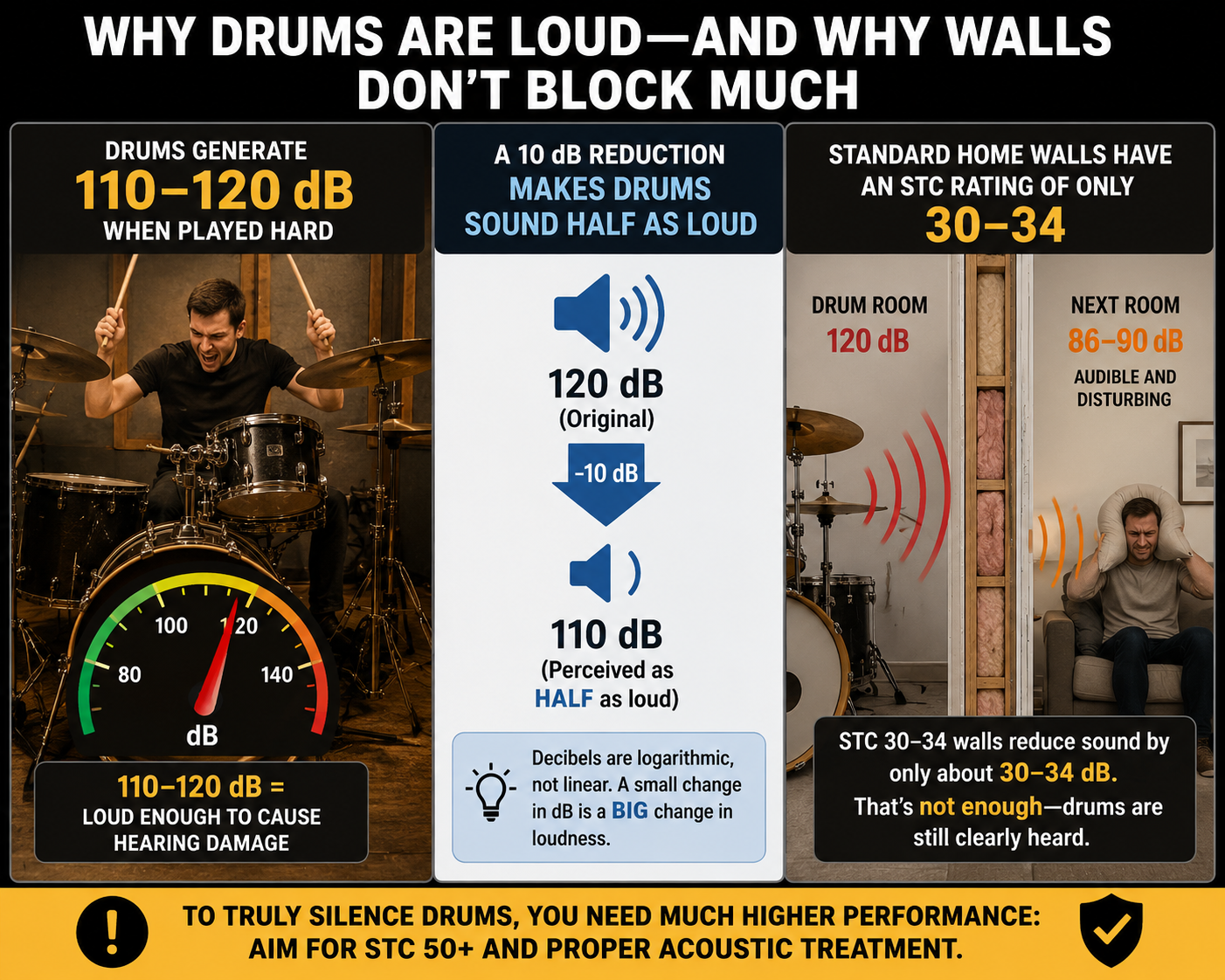
Some Facts that You Need to Know about Drum Noises
Here’s the image which shows the interesting things that you need to know. The source of these data from, Second Skin Audio, and AUDIMUTE.
Understanding Drum Noise Problems
There are two kinds of noise problems related to the drums, and each has its own characteristics; hence, it needs its own solution to be fixed.
- Airborne noise
Airborne noise is caused by the snare and toms. The vibrations in the air can easily escape through the walls and windows.
- Structure-borne vibrations
Structure-borne vibrations are more difficult to manage. It refers to vibrations caused by the kick drum, which travels through the floor and other parts of the structure.
It should be emphasized that low frequency vibrations are more difficult to manage than high frequency vibrations.
How to Soundproof a Room for Drum Practice?
Find your rooms weaknesses
Do not spend your money before your rooms have been inspected for weaknesses. Weaknesses are the paths through which sound escapes and they are such as:
- Thick walls, single-pane windows and shared walls
- Empty doors
- Vents, electrical sockets and plumbing
- Cracks in your door
- Space under the door
Even minor spaces in your room could lead to considerable sound leak. Instead of buying unnecessary objects for your money, it is best to plug the weaknesses.
Note that not only your room influences the rate at which sound leaks but also the environment around it. For an apartment, it would be vibration in your floor, whereas for a house, it would be a window or wall.
Soundproof the floor (Essential for drums)
The floor plays the most important role in making noise due to vibrations from the kick drum.
DIY
Best is to build a drum set riser which is a raised wooden platform, which is put on rubber pads or isolation materials.
This will help in keeping the drum set elevated from the floor.
Budget-Friendly
For a budget-conscious drummer:
- Buy heavy rubber mats, which are generally used in gyms or stables
- Add carpets on top
- Use rubber or foam under the pedal
This won’t completely block all vibrations but will definitely reduce it to a great extent.
Professional Solution
Floating floor systems are common in studios. This involves creating an isolated floor for the whole drum kit. Though it’s extremely expensive, it does an excellent job.
Soundproof the walls
Walls are one major contributor towards leakage of sound especially in apartments.
Add Mass
Having more mass in walls will absorb sound, so you can use:
- A second sheet of drywall
- Mass-Loaded Vinyl (MLV)
Seal all openings
Acoustic sealant should be used to seal any cracks or joints, corners and openings like electrical outlets in the walls. Sound behaves like water as it finds any gap to escape.
Decoupling (advanced)
It is when you use resilient channels or clips to separate the wall layers so that vibrations do not pass directly through one layer to the other.
Rental solution
If changes cannot be made to walls:
- Push in a lot of furniture like bookshelves
- Fill it up with books so it adds mass to the walls
Soundproof the door and window
These are the most sensitive spots in a room for letting the noise out.
Door Improvements
If it’s possible, use a solid core door instead of a hollow door.
Use weather stripping around the edges and install door sweeps at the bottom of the door. The small gaps at the bottom of the door are enough to let a large amount of sound out.
Window Solution
- Thick black out curtains
- Window plugs (can be installed and removed as required)
- Acrylic double panels
Reduce noise at the source (for drums)
Apart from improving the soundproofing of the room, it is important to reduce noise from the source as well.
Mesh Heads
Instead of acoustic drum heads, use mesh heads, which produce a lower volume level. They have a feel close to the traditional acoustic drum heads.
Silent Cymbals
They have been engineered to produce less noise.
Muting accessories
- Gel pads
- Drum rings
- Use of towels
Electronic drums
These are ideal for silent practice as they are designed to make little to no sound.
Acoustic Treatment (soundproofing inside the room)
The primary purpose of this is to improve the sound inside the room, now that sound leak has been minimized.
- Foam panels help reduce echo
- Bass traps help control low frequency sounds
Rugs and curtains can absorb a certain amount of sound, preventing it from reflecting around the room.
This step would result in a good-sounding room but not one which will completely keep noise contained within.
Budget-friendly set-up plan
There are several set-up strategies depending on your budget:
If you are short of money:
- Rubber mats
- Door sealing
- Curtains
- Muting
If you have some money:
- Drum riser
- Wall treatment
- Improved doors and windows
If you have a larger budget:
- Floating floor
- Double walls
- Isolation
Common Mistakes to Be Aware Of
- Employing foam panels only (not soundproof)
- Disregarding floor vibration
- Not filling gaps on doors or windows
- Working on just one aspect of the room
- Anticipating silence without any structural modifications
Conclusion
Soundproofing of your practice room involves many things. You require the implementation of several measures since there is no one particular method of solving the issue. These include floor insulation, eliminating air leakage, window and door modifications, as well as reducing drum sounds.
While complete sound insulation may not be possible without building an actual studio, you are sure to succeed in reducing the noise level considerably with the help of the measures listed above. You can also check out amazing drum set at Amrit Music.
FAQs
Can I completely soundproof my room for drums at home?
It is hard to do so; however, one can considerably diminish noise through flooring isolation, gap filling, and adding mass to the walls and doors.
Will foam help to soundproof the drum room?
Foam will not be able to soundproof your room; rather, it will minimize echo and improve sound inside the room. To prevent noise from the drums, one needs to use dense materials such as drywall, rubber, and mass-loaded vinyl.
What is the most affordable option for reducing drum noise?
Rubber mats, door gap filler, and curtains are the most inexpensive options to make practice somewhat quieter for the neighbors.
Why is the kick drum the hardest one to isolate?
Kick drum produces vibrations with low frequencies that spread through floors and walls. Thus, it is particularly challenging to soundproof the instrument due to its vibration.
Are electronic drums better than acoustic drums when it comes to soundproofing?
Yes, electronic drums produce very little sound that travels through air. Such drums will suit you well if you live in an apartment because they address all sound problems without compromising your practice sessions.
Will carpets help in silencing drum sounds?
Carpets will help in lowering the noise to some degree because of their shock-absorbing capabilities but they won’t completely soundproof your room on their own.