
While spending only 10 minutes on forums dedicated to the guitar you will see that members often express high degrees of both knowledge and emotion about this topic. On one side there are users who insist that real tonewood or solid top is worth owning and laminate is inferior. The others say that laminate is perfectly suitable and is cost effective. But so who is correct?
It largely depends on your requirements and budget. Typically, solid top guitars are understood to offer superior, more complex and vibrant sound. Laminate guitars, on the other hand, are generally more affordable and are typically seen as sturdier and more consistent. These qualities are particularly appealing to novice or even intermediate guitarists.
Understanding the distinctions between laminate and solid top guitars is significant before purchasing the one. Below is explained solid top vs laminate guitar, how each type of acoustic guitar is constructed and also details the associated sound they generate.
Key Takeaways
- Generally, solid top guitars offer superior, more vibrant and diverse sound.
- Typically, laminate guitars are more affordable and robust.
- As solid top guitars age, their sound often develops further.
- Laminate guitars are usually more tolerant of variations in temperature and humidity.
- Although perfectly suitable for novices, should additional sound quality be required then a solid top guitar should be selected.
Your affordability, level of experience, surroundings and musical requirements should all be taken into consideration when making your decision.
Solid top and Laminate Guitar – Explained
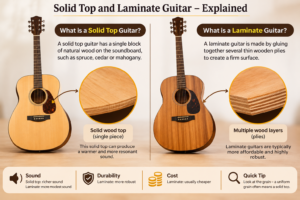
Below is firstly explained the true meaning of each term.
What is a Solid Top guitar?
Rather than a number of wooden plies that have been laminated together to construct the top soundboard, a solid top guitar has a single block of natural wood. Again, this will typically be a type of tonewood for example spruce, cedar or mahogany. It is this section of the guitar that causes much of the sound to be generated by vibrating in response to the guitar strings being played.
As a result of this solid top being constructed from solid wood, the guitar is generally perceived to offer a more vibrant and sonorous sound. However, it is not always the case that a solid top guitar is entirely built from solid wood. Occasionally, the guitar back and sides will be made from laminated wood.
What is a Laminate guitar?
Unlike solid top guitars, laminate guitars are created by gluing together a number of thin wooden plies to produce a firm yet less sonorous item.
For a completely laminated acoustic guitar, the top, back and sides will all be constructed from wooden plies. Usually, this type of guitar is not only more affordable but is also robust and so is convenient for use and transportation.
Solid Top vs Laminate Guitar: Comparing the Important Factors
1. Sound Quality and Tonal Richness
Often people consider audio when considering solid-top and laminate guitars.
As compared to laminate, solid tops tend to create a more complex and rich tone. As a result, a player can access a greater degree of tone and natural reverb and is able to further develop their playing.
Whilst laminates do not usually match solid- top guitars for natural reverb, they are generally capable of providing a well-rounded tone. This can be suitable for self practise, teaching and even informal playing.
Winner – Solid-top guitars, especially for those wishing to benefit from an enhanced and more emotive tone.
2. Volume and projection
Projection is about how well a guitar can both generate and project sound outwards.
As previously mentioned, solid-top guitars are often superior in this respect as they can utilise string movement more effectively. Again, especially in an un-amplified acoustic environment, solid-top guitars are often able to provide a richer and more projecting tone.
Laminate guitars too can create adequate volume for self-practise, small groups and even for those just starting to play in front of others. Nevertheless, depending on the specific model, and in conjunction with factors such as body size and build, laminate guitars may not project sound to the same extent as solid- top guitars.
Winner – Solid-top guitars if you desire greater acoustic projection and emotive qualities.
3. Resistant to Deformation and Weather Fluctuations
For musicians who bring their instrument for practice and performance every week, a good build quality is an important point.
Compared to humid conditions natural solid wood is also sensitive. If your guitar is subjected to humid or fluctuating temperatures, the solid wood can change and lead to cracks, warping or other damages if it isn’t stored correctly.
Laminate is more stable than solid wood because the multiple veneer layers that are joined under pressure provide resistance to movement caused by temperature or humidity changes. This is why laminate guitars are generally considered a practical choice for students, travelling musicians and others who need an instrument for daily use.
But it doesn’t mean laminate is totally immune to damage. Extreme heat, moisture, physical impact and bad storage can all take a toll on any guitar.
Laminate Guitars- For players who want a guitar that can withstand the elements.
4. Cost and Total Value
Your budget usually determines the new musical instrument that you should go for.
Pricing for solid-top guitars is usually higher because they need specific tonewoods and more complex manufacturing techniques. For a dedicated player, a solid-top guitar can be a good investment, especially if you want more tonal range from your instrument and you’re committed to improving your guitar skills.
You can generally find them at cheaper prices. The construction of a laminate guitar allows the inexpensive entry of people wanting to learn the guitar but who are not willing to make a big purchase up front.
It is important to remember though that the least expensive Laminate guitar is not always the best buy. A poorly built solid top guitar can be a better buy than a costly laminate.
Winner: Laminate guitar for cheap, solid-top guitar for more sound. There is a debate, not so much between classes, but between types of guitars.
5. Maintenance & Long-Term Care
Both types of guitars need maintenance but generally, the solid-top guitars will be more labor-intensive. Solid wood reacts to changes in humidity; therefore, storing the guitar in a quality case, avoiding the sun and keeping away from extremes of temperature will go a long way to protect the guitar’s structure.
The laminate guitars aren’t quite as sensitive to temperature changes as the solid and can be kept in different environments with less fuss.
However, the guitars should still be cleaned, strings replaced, stored away from extremes of temperature and humidity and should be set up from time to time.
Winner: Laminate guitars for those who like low-maintenance instruments.
6. What Guitar Is Better for Different Playing Styles?
Your playing style and what sort of music you play are also factors to consider when choosing a guitar. Here’s a comparison of how each version would perform for various playing styles.
Fingerstyle Guitarists.
For fingerpicking and other intricate styles of playing, the detail, responsiveness and harmonic complexity of solid-top guitars generally excel.
Strumming & Rhythm Players.
Solid-top and laminate guitars are both suitable choices for rhythm playing. Solid-top guitars generally have a richer resonance but laminate models will also produce a clear and balanced sound.
Singer-Songwriters.
Those who perform with a guitar and vocals may favor the fuller sound and increased tonal complexity of a solid-top model, but the ultimate decision depends on the guitar’s shape, tonal characteristics and the likely need for amplification.
Beginner Guitarists.
Laminate guitars are often a wise choice for new guitar players as they tend to be more affordable and durable, making them ideal for practicing scales, chords, techniques and strumming patterns.
Travelling Guitarists.
If you plan to transport a guitar as you travel between destinations, the more stable environment of a laminate guitar may be preferable.
7. Is a Solid-Top Guitar More Expensive?
If you need a better tone, pay for a solid-top guitar. It can be worth the investment. A more responsive tonal range, naturally resonant sound and potential tonal development can be noticeable when playing with other musicians and even more so as your own playing matures.
But more expensive doesn’t always mean better. You still need high quality tonewoods, good body, bracing and other factors to hear the true difference from a solid-top guitar.
Smaller laminate bodies may be all you need for playing chords and practicing, while touring musicians playing on stage, recording music and advanced techniques may benefit from solid-top design.
A nice compromise is a solid top but laminate back and sides, providing some tonal improvements in a cheaper package.
8. How Do I Know Which Guitar to Buy?
Here are some factors to consider if thinking about purchasing a guitar. Look and listen to what’s on offer to see whether it’s a solid top, laminate or all-solid construction.
- Listen to the sound
- Check playability and action
- Look at construction and quality of craftsmanship
- Consider where and how you’re going to use the instrument
If you’re not sure, it’s well worth chatting to an expert in a musical instrument shop.
Why choose Amrit Music?
People often need help to select a suitable guitar. Being able to view a large and appropriate range of instruments and receiving helpful advice can prove extremely beneficial for many people.
Amrit Music has been trading within the musical instrument sector for over 50 years. It sells a broad array of musical items such as acoustic and electric guitars, keyboards, drums and amplification systems alongside associated musical products.
Whether you are a novice wishing to purchase your initial acoustic guitar or an experienced musician keen to try out new instruments, Amrit Music can supply an array of musical equipment from reputable brands.
Drawing upon its knowledge of the music marketplace and offering such a broad range of goods, Amrit Music can therefore be a great place to shop for a suitable guitar that both fits your style and price range.
Contact Amrit Music
Email: info@amritmusic.com
Phone Number: 011-41042425, 8826004630
Regional Office: E-103, Ph-7, Industrial Area, Sector 73, Sahibzada Ajit Singh Nagar, Punjab, 14030.
Conclusion
Having now examined solid top and laminate guitars, it is dependent upon your needs, together with your level of experience and price range, as to which type of guitar is most appropriate for you.
Whilst the audio produced by a well-made solid-top guitar is typically of a higher standard, if you simply wish to own a cost-efficient and sturdy guitar, then an appropriately made laminate guitar can also perform very effectively for you.
Above all, the most favourable guitar for an individual is one which is pleasant to play, and which also pleases the ear – so that the person is motivated to continue to play.
Frequently Asked Questions
Is a solid top or laminate guitar better?
Generally, a solid top guitar produces a warmer and more sonorous sound than a laminate one. It also has a tendency to be more sensitive and to have a greater range of sound. The actual sound will be affected by the type of wood, build quality, guitar body and set-up.
Does the sound of a solid top guitar enhance with age?
Yes. A solid top guitar can improve in both sensitivity and range of sound. Factors such as regular playing and natural ageing of the wood may help to do this. Again, however, different solid top guitars will show differing degrees of enhancement.
Are solid top guitars more costly?
Usually, yes. As solid top guitars are made from specially chosen solid tonewood and are more intricately built, they are often more costly than laminate guitars. Laminate guitars are typically cheaper to manufacture.
Are laminate guitars more robust?
Generally yes. Laminate guitars are more stable and so are typically more tolerant of variations in both temperature and humidity. Solid wood guitars need to be stored more carefully in order to avoid them warping or cracking.
How do I recognise a solid top guitar?
Look at the grain pattern on the inner rim of the sound hole. Usually, solid wood will have a uniform grain throughout. Laminate guitars will often show a number of separate layers within the wood. Furthermore, information regarding a guitar’s build can also be found on its manufacturer’s specification sheet.
Does laminate impact upon a guitar’s sound?
Yes. Laminate can affect the action of a guitar’s sound board and its reaction to the strings. Typically, laminate guitars have a less complex and sonorous sound than like-for-like solid top guitars. Nonetheless, a guitar’s sound is also contingent upon its design and build.