
Learning how to read sheet music for wind instruments is one of the most fulfilling things that a musician can learn. If you have recently started playing the flute, the saxophone, or the clarinet, then one thing is constant. Want to understand the mystery of what all those dots and lines mean? This guide will walk you through the whole process from beginning to end. No musical degree needed. All you need is the right amount of patience, a little theory and your instrument close at hand.
Understanding The Musical Staff And Treble Clef For Wind Instruments
Every piece of sheet music is built on a staff which is five horizontal lines with four spaces between them. Different notes are put on the lines and spaces of the staff, representing the pitch of the note. The further up the staff the note is, the higher it will sound, and the lower it is, the lower.
The very first symbol found at the beginning of each musical score is a clef symbol, which helps understand the meaning of the five lines on the staff. Most of the wind instruments, such as flute, oboe, clarinet, trumpet, and saxophone, use the treble clef, which is also known as the G clef. It gets that name because its curling symbole basically wrapes around the second line from the bottom. This represents the note G above middle C.
Treble Clef Notes: Lines and Spaces Explained for Beginners
Lines (bottom to top): E – G 0 – B – D – F | Mnemonic: “Every Good Bird Does Fly”
Spaces (bottom to top): F – A – C – E | Mnemonic: “FACE in the space”
Ledger lines then extend the staff above and below for the notes that are outside this range. Middle C sits on a shorter ledger line just below the treble clef staff.
Exception among the woodwinds would be the bassoon, which mostly uses bass clef notation but moves up into tenor clef at higher pitches. Of the brass instruments, the trombone and tuba use bass clef as well. If you are learning flute, sax, clarinet, or trumpet, you will use the treble clef.
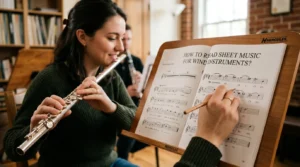
How to Read Sheet Music for Wind Instruments: The Basics
Reading Note Values and Rhythm in Sheet Music
The pitch tells you which notes you have to play. The rhythm tells you for how long to play the note. Each note value in music notation has a rhythmic value. So understanding this is just as important as it is to know your notes.
Common Note Values:
Whole note – 4 beats (open oval and no stem)
Half note – 2 beats (open oval with a stem)
Quarter note – 1 beat (filled oval with a stem)
Eighth note – ½ beat (filled oval and stem with one flag or beam)
Dotted note – the dot adds half the note’s value (e.g. a dotted half note = 3 beats)
Rests – silence symbols matching each note value. Silence shapes music just as much as sound does
In terms of rhythm practice, count aloud as you play. The beginner tends to focus too much on pitch, while overlooking rhythm, which is something that cannot be separated from breathing in wind instruments.
Time Signatures vs Key Signatures: Easy Guide for Beginners
Following the clef, there will be two numbers placed one above the other in a composition; this is called the time signature. It helps you understand how the rhythm in each bar is to be played. In 4/4 time signature, there are four beats in a bar, while in a 3/4 time signature, there are three beats per bar.
Beside the clef is another marking called the key signature which consists of sharps (♯) or flats (♭). An example of a G major key signature has only one sharp (F♯). It means that each time an F is played, it will be an F-sharp unless stated differently. It is important to learn your key signatures early so you can avoid reading every accidental separately.
Quick rule: Any sharps or flats that are within the key signature actually apply for the whole piece. Any sharps or flats written directly before an individual note (accidentals) are only for that bar.
Transposing Instruments in Wind Music: What Beginners Must Know
This is the part which trips up most of the beginners so be extra careful here. This is specific to wind instruments. A lot of them are transposing instruments which means that the pitch that sounds is different from the pitch that is written on the page.
| Instrument | Transposition Key | Written C sounds as… |
| Flute / Oboe | Concert pitch (C) | C – no transposition |
| B♭ Clarinet / B♭ Trumpet | B-flat | B♭ – a major 2nd lower |
| Alto Saxophone | E-flat | E♭ – a major 6th lower |
| Tenor Saxophone | B-flat (+ octave) | B♭ – a major 9th lower |
| French Horn | F | F – a perfect 5th lower |
| Bassoon / Trombone / Tuba | Concert pitch (C) | C – reads bass clef |
It is not necessary to transpose things on the spot because all that needs to be done is look at the notes and play using the appropriate fingering required by one’s instrument. What is important is when more than one person performs together; a B-flat clarinet will sound different from the piano playing the same written part. So it’s important for each player to get their own transposed part.
Music Dynamics and Articulation Marks Explained
As soon as you become familiar with reading notes and rhythms, then the next step for reading sheet music would be expression. The notation for expression is mostly written in Italian, the international language of music.
Common Markings to Know
p (piano) – soft | f (forte) – loud | mf (mezzo-forte)– moderately loud
Crescendo (cresc. / hairpin opening out) – gradually get louder
Diminuendo (dim. / hairpin closing in) – gradually get softer
Legato (slur) – a curved line over notes means play them smoothly connected
Staccato (dot above/below note) – play short and detached
Accent mark (>) – emphasise that note with a stronger attack
As a wind player, this notation controls your breathing and tonguing. Slur notation means that you use the tongue on the first note, while the remaining notes are played by using airflow continuously. Staccato notation requires a clear tongue stop.
How to Read Sheet Music for Wind Instruments Faster: Practice Tips
Reading sheet music is a layered skill for wind instruments. This is pitch, rhythm, articulation, dynamics and transformation all on the same page at once. The key here is to learn each of the layer in isolation before you combine them. So start with simple tunes in C major (no sharps, no flats. And first focus on placing the notes correctly. Then you add rhythm nex and then dynamics. Then push into keys with one or two sharps or flats.
Always practise sight-reading on a daily basis, no matter what – it’s better to practice for just ten minutes with new music rather than an hour with music that you are already familiar with. Use a metronome. Tap your foot. Slow down any difficult passages to perfect them.
One last tip: As you’re reading the notes, sing or hum along with it. This helps ensure that your brain interprets the musical notation in terms of music, rather than in terms of just notes on a page, and builds up your ability to hear music in your head.
Conclusion
Reading music for wind instruments isn’t something that you learn in one lesson; it’s something that builds up week after week. Yet each time you come back to a new page of music, it becomes a bit more natural. Just keep at it, stay interested, and the music will become like a second language that you cannot play without.
Frequently Asked Questions
Q – Do all wind instruments read the treble clef?
A – Woodwind family members such as flute, clarinet, oboe, and saxophone play notes using the treble clef system. The only exception is bassoon which uses the bass clef system and then uses the tenor clef for higher notes. For brass instruments, trumpet and French horn use treble clef, while trombone and tuba use bass clef.
Q – What is a transposing instrument?
A – The transposing instrument is an instrument that sounds at a different pitch from the one notated in the score. The B flat clarinet, for instance, notates C but sounds B flat – a whole step lower. The E flat alto saxophone notates C but sounds E flat – a sixth below. The reason why this is done is to allow musicians to transpose between various members of the family of instruments using identical fingerings.
Q – How long does it take to learn to read sheet music for a wind instrument?
A – Recognising notes on the staff and being able to play them from music can be achieved by most beginners in just a few weeks through consistent training. Being able to sight-read, which is the ability to play a new piece of music instantly after seeing it, usually requires a few months up to a year or longer.
Q – What is the difference between a key signature and a time signature?
A – Key Signature is represented by sharps or flats on the first line of a staff. The key signature shows us which notes are to be raised or lowered. Time Signature: It consists of two numbers one on top of another. The upper number tells us about the beats per measure, whereas the lower number indicates the value of one beat.
Q – What are ledger lines in sheet music?
A – A ledger line is a short horizontal line that is used above or below the five lines of a music staff to write notes beyond the limits of the staff. The note of Middle C, for instance, is written on the ledger line below the treble clef staff.
Q – Can I learn sheet music without a music teacher?
A – Yes, indeed. Many musicians get acquainted with the basics on their own. But a teacher will be able to notice your mistakes in technique, teach you about special notations for your instrument and speed up the process. This is particularly important for wind instruments, when embouchure and breathing join reading music.