Learning how to read guitar tabs may be the fastest way to start learning how to play guitar tunes even without knowing how to read musical notations. Guitar tablature, commonly called “guitar tabs,” is a simple way of identifying where exactly you should position your fingers when playing the guitar. In contrast to traditional music notations, you do not need to know the complicated symbols and musical notations in reading guitar tabs; all you have to know are simple guidelines written in lines and numbers relating to each guitar string.
This manual contains everything you need to learn about guitar tabs including how to read them, how to interpret guitar tab rhythms, symbols, and many more!
What are Guitar Tabs?
A guitar tablature is described as another form of notation that is commonly used in stringed instruments like the guitar. Unlike traditional notations, guitar tablatures are simple and straightforward as one only needs to know where to put the fingers on the guitar.
Guitar tabs consist of six horizontal lines symbolizing guitar strings. The order of the lines from top to bottom is as follows:
- High E string
- B string
- G string
- D string
- A string
- Low E string
Numbers written on these lines symbolize where to place the fingers. Number three on the bottom line would mean the 3rd fret of the low E string. Tablatures have become very popular because of their simplicity. Also, they are related to the instrument, and anyone can easily learn how to play after a few minutes.
Also learn: Types of chords in guitar.
Understanding the Guitar Tab Layout

For correct reading of tabs, it is necessary to understand their structure at first.
Six String Lines
There are 6 horizontal lines overall. Each of them represents some guitar string. It should be noted that tablature is oriented in reverse order compared to real view of your instrument.
- Top line represents the thinnest string
- Bottom line represents the thickest string
Numbers on the Lines
On each line, numbers indicate which fret you should press:
- “0” represents an open string, no fret pressing
- “1” represents the first fret pressing
- “2” represents the second fret pressing, etc
For example:
e|–0–
B|–1–
G|–0–
D|–2–
A|–3–
E|—–
It is implied here that all those notes must be performed simultaneously; in other words, you should perform a chord.
Order of Reading
Tabs must be read from left to right as any written material.
Basic Symbols Used in Guitar Tabs
Once you have grasped the idea of numbers, there are some special symbols for helping you identify how to perform playing techniques.
Common Tab Notation
- h (hammer-on): Pluck one note, and hammer on another fret without plucking it.
- p (pull-off): Remove one finger from the fretboard in order to play the note under it.
- / (slide-up): Slide up the fretboard with your fingers.
- \ (slide-down): Slide down the fretboard with your fingers.
- b (bend): Increase the pitch by bending a string.
- r (release bend): Release bend in order to get a regular pitch.
- x (muted note): Perform the note but with the muted strings.
Importance of Notations
These notations provide information not only about the notes which need to be played, but also about how they can be performed. Despite the fact that two guitar players play one tablature, they can have different performance because every player has his own techniques.
Also Read: Types of Guitar Strings – A Complete Guide
How Rhythm Works in Guitar Tabs?
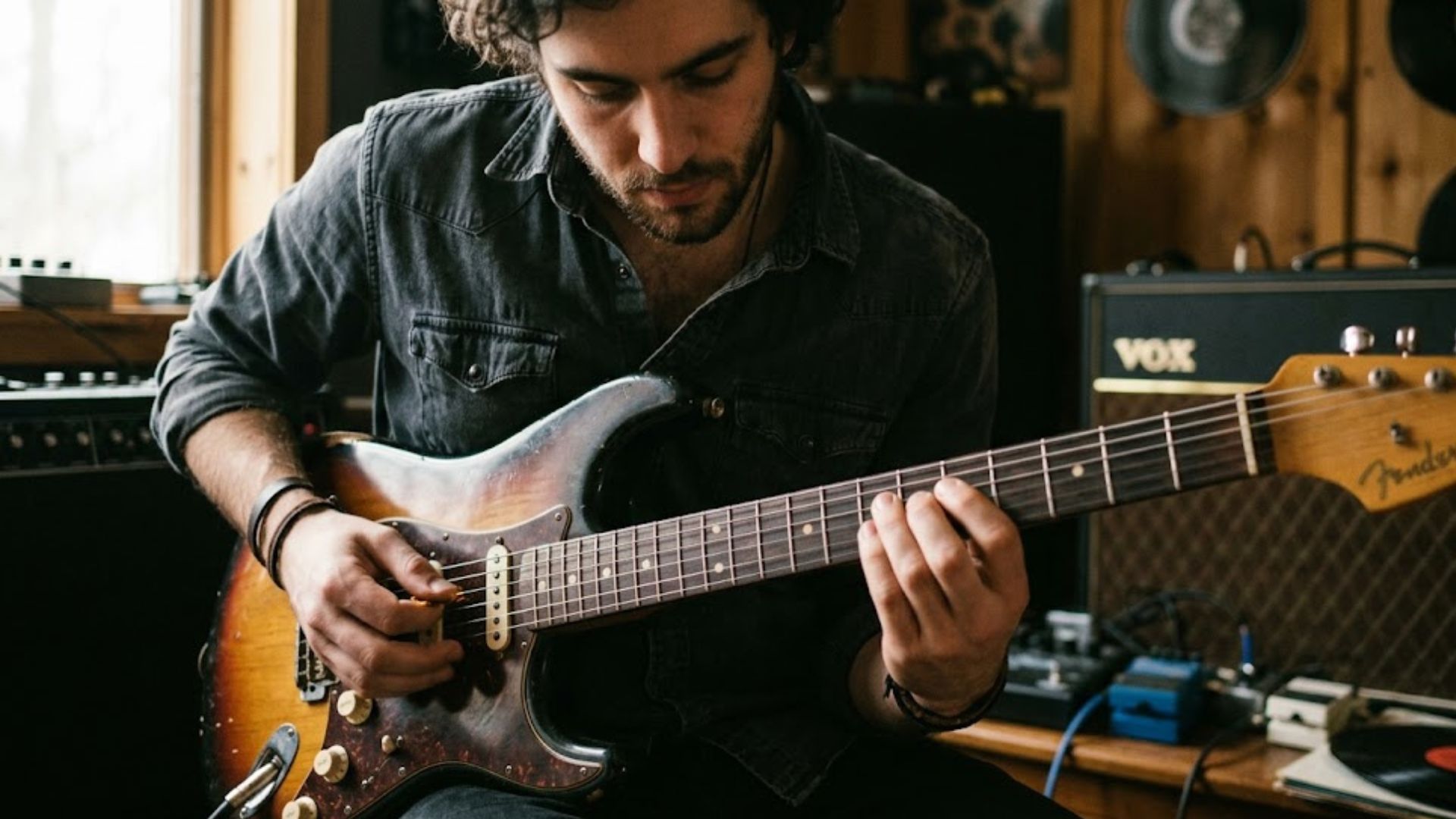
One of the drawbacks of tabs is that it does not imply rhythm or timing per se. Where as in musical notation, the value of the note is indicated by certain symbols, in tabs, spacing comes into play, as well as the need to listen to the song.
Understanding Timing
- Spacing among the numbers might give some indication as to timing.
- Proximity of numbers = quick notes
- Distances between numbers = slow notes
But this is not always true.
Listening is Crucial
To successfully play a song, it is imperative to listen to the song while playing the tab.
Use a Metronome
This would help in keeping the rhythm consistent. The tempo can be slowly built up.
Here’s the besic guide about how to tune a guitar.
How to Read Your First Guitar Tab?
Step 1: Get Used to the Strings
There are six strings in a guitar and are arranged from highest to lowest in order of E, A, D, G, B, and e. The highest row in guitar tabs corresponds to the thinnest string while the lowest corresponds to the fattest string.
Step 2: Be Familiar with the Numbers
Guitar tabs contain fret numbers which are combined with strings and shown as numbers.
Step 3: Learn at Your Own Pace
Practice guitar tabs from left to right hitting the notes individually.
Step 4: Compare It with the Original Song
Make sure you listen to the song carefully and practice it accordingly.
Step 5: Practice Continuously
Try to break difficult parts into simple sections and practice them continuously.
Common Issues Faced by Beginners
These errors arise out of carelessness rather than the complexity of using tabs:
- Confusion on the string sequence (higher strings vs lower strings)
- Going faster without learning how
- Inability to focus on timing
- Not tuning your instrument
- Lack of familiarity with the real song
- Learning only from tabs
If you avoid making such errors, you will emerge a better guitar player.
Tips to Improve Tab Reading Skills
Guitar Tabs Reading Ability Improvement Tips:
- Start by practicing really simple tunes first
- Practice on a regular basis, even if it is for short durations like 10–15 minutes
- Before playing tune your guitar
- Reduce tempo of your favorite tunes through playback capabilities
- Learn different kinds of chords
- Practice with tabs while listening to music at the same time
- Do difficult parts repeatedly instead of skipping them
Also read: Tips To Choose The Best Guitar Strings.
Consistency beats lengthier practices.
Suggestions for Beginner Practice Exercises
Exercise 1: One String Exercise
Practice by strumming notes just on the highest E string.
Exercise 2: Basic Riffs Practice
Practice basic 3 to 5 notes long riffs often.
Exercise 3: Simple Chord Tabs
Switch between simple guitar chord tabs like G, C, and D.
Exercise 4: Time Practicing
You can utilize a metronome while playing at slow speeds.
Beginner-Friendly Songs
Play songs that feature easy chords or riffs. Many songs have been arranged into a beginner format using tabs. Choose songs that you already know so that your ear can guide your playing. With improved ability, learn more difficult songs with more transitions and skills.
Check the list of top 10 songs to play on guitar for a beginner.
Steps After Learning Tabs
After you have mastered reading tabs, the next step will be learning:
- Fingerpicking on guitar
- Advanced picking techniques
- More advanced bending and sliding techniques
- Rhythms along with tabs
- Music theory
- Writing your own riffs
Tabs are just a starting point for playing guitar.
Conclusion
Reading guitar tabs may well be the easiest and fastest way for a novice guitarist to learn how to play his guitar. All he needs is to be conscious of some elementary knowledge concerning lines, numbers, and symbols. Nonetheless, it takes a lot of time and patience for the novice guitarist to learn to read guitar tabs. The trick is to begin slowly, practice often, and gradually increase speed and difficulty levels. With this approach, there comes a time when the novice guitarist will no longer have to focus on reading guitar tabs but rather on playing music.
FAQs
Which is simpler, guitar tablature or sheet music?
The guitar tablature is simpler to understand for beginners compared to sheet music as it employs the visual approach of how fingers will position while playing the song instead of knowledge of music theory. Guitarists that are beginners tend to begin by studying guitar tablatures then proceed to sheet music.
What does “0” mean in guitar tablature?
In guitar tablature, “0” indicates that the note will be played without pressing the string into any frets. Open notes are common in beginner guitar tunes.
Why do tabs contain letters and symbols?
The use of letters and symbols in tabs indicates the methods that have been applied in playing guitar such as hammer ons, slides, bends, and pull offs. This is important because it makes the guitarist play the notes in the right manner.
Is it possible for me to master the guitar playing skills using tabs alone?
Sure, there are many students who start learning to play the guitar using tabs alone. However, including rhythm practice, listening exercises, and some elements of music theory in your study will improve your mastery skills.
How can I acquire the skills to read tabs?
To read tabs, use daily exercises on tabs with easy songs and exercises. Be patient, concentrate on accuracy while playing and listening to the music simultaneously.